
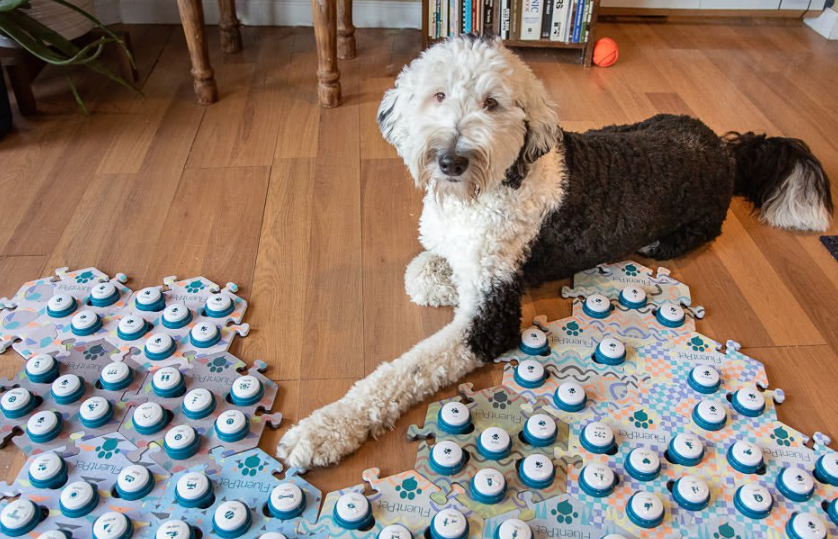
Have you seen Bunny the sheepdog poodle cross using buttons that speak words?
In 2019, Bunny’s human Alexis Devine partnered with the University of California to use “talking buttons” to study Bunny’s capacity for understanding language. I came across Bunny in 2020 and thought, “well, with this going mainstream people are going to understand their pets so much better!”
It’s been years now, and while there are a few more creators online showing how their beloved animal friends use buttons to communicate with them, the talking buttons really haven’t taken off the way I thought they would, and I have a theory about why:
I think people don’t always understand how animals experience the world, how they think, and put together expressions. A lot of people assume animals think in words the way that many humans do, and I think that’s the biggest barrier for successful button communication!
Are buttons even necessary?
It depends. In my experience, the people who book sessions with me are already very tuned into their animals wants, needs, preferences, and even humour. This too could be a factor with successful button use – it takes a LOT of work to build up the vocabulary, and a lot of patience. Most tuned-in pet owners don’t need a button to know when their cat wants their litter box scooped or when their dog wants outside.
The fascination with buttons comes in when your pet already understands the buttons are for communication, and they have at least 10 to choose from – THEN they can start putting surprising sentences together.
Buttons aren’t necessary, but they sure can be fun!
If you have the time and inclination to devote to introducing talking buttons, plan to give it at least 6 months. The first buttons you use will be boring but easy, and your pet will IMMEDIATELY abuse them! Don’t get discouraged!
If I gave my cat Rupert an “outside” button, he’d be leaning on that thing every 30 minutes once he figured out what it did – or what it made ME do. This is why you have to introduce the “later” button pretty early on, and have patience with the process.
Rubert “Outside”
Me “Outside, Later”
Rupert “Outside Outside Outside Outside”
There’s a reason your typical animal guardian gives up in this phase! They’ll lean hard on the button usage when they only have a few, but if you’re able to stick with it until you get to the describing your environment stage, I strongly encourage you to do so!
The next stage of button introduction is associating environment descriptors. I know people with buttons for their daily routines, as well as buttons for neighbours, strangers, worries, and pain. Cats LOVE to keep their humans on a schedule, so if you want help remembering to take your laundry out of the washer and into the drier, give your cat a button for “laundry” and push it every time you go to the machines. They’ll catch on quickly and press the button if they’re expecting you to attend to the laundry and you’re delaying doing it.
If you have trouble remembering to take medications – set alarms please – but also give your cat a button and you push it every day when you take your medicine on time. You can silence an alarm and forget it rang, but you sure can’t silence a persistent cat who is expecting you to do something!
I think this is a very under-utilized potential of buttons! We see a lot of videos online of animals being funny with how they put thoughts together using the limited button selection, but at the end of the day animals are among the beings who know us best on earth! They spend the majority of their lives paying attention to us, and they want to participate in our lives.
That’s why I think the buttons have such great untapped potential for the people who have the time to build the complexity. Yes, animals can use them to communicate wants and needs – and I actually think more large livestock should be trained on buttons if they’re going to live and work with humans during a long life. It makes a big difference for a horse to be able to ask staff at their stable to take off or put on their blanket, to alert something is wrong with the food or water, or to indicate they’re in pain before they’re so terribly ill their lives are in danger.
Do you think your household would benefit from talking buttons?
Again, it all depends! Do you want your pet to help you in some way? Have you ever wondered what they want, or what they are thinking? Do you want them to be able to specify which treat, toy or food?
Buttons can be so helpful for cats sensitive to dirty litter boxes – so many cats will start to pee outside of the litterbox if it’s not cleaned to their satisfaction, so in that case it’s easy to get a single button and hit it every time you clean the litter box – the cat will catch on quickly!
One thing I’m not especially a fan of is humans using rude language with the buttons. I’ve seen some button videos where the dog hits a button that says “feed me bitch!” or other rude things. I feel like everyone should be in on the joke, and the rude buttons have always felt like a prank on the pet to me, like naming a big unneutered male dog “Princess”. They don’t know why their humans laugh, they just know the buttons get a reaction and what the response would usually be. My preference is keep the buttons honest!
Do you need to use buttons with your pet?
Nope! Our pets have mastered the art of making it obvious to us what they want and need. When hurt, most pets will request help from their humans if their person hadn’t already noticed they need it. When we share our homes with pets we notice if something’s off pretty quickly (unlike with horses in the field or the barn where things can go sideways for hours before a human notices. I think horses need buttons that send text messages to their human’s phones.)
As I mentioned, if I gave Rupert an “outside” button, he’s abuse that thing day and night until we had completed the process of building the complexity of his button language he had more options. Rupert has developed asthma in his senior years, and I was thinking of getting him a button for “medicine” just in case he needed to alert us if he needed his rescue puffer and we were absorbed in something else – but Rupert is such a great communicator he solved this potential problem himself. If he wants his puffer he comes up to one of us and then hack / coughs dramatically, then goes to his spot on the cat tree or couch where we routinely give him his medicine. He doesn’t go through this performance often, so I’m satisfied that he’s only asking for extra medicine when he needs it and not just for the extra treat he gets after he cooperates, allowing us to administer his puffer.
Even as an animal communicator I am not always paying attention, and I’ve considered buttons – but my pets are so obvious about their needs and expectant that I will attend to them as soon as I understand what’s up, they’re really obvious and creative with their physical communication! I have zero worries about missing something with them.
If you think your pet needs a button to communicate comfort needs – absolutely get one! It’s simple and easy to introduce buttons even for a single purpose. I have a friend with an elderly dog who uses metacam pain relief medicine to manage his arthritis, and rather than wait until her dog is so sore he struggles to get up, she brought in a talking button just for his pain and medication.
She introduced an “ouch!” button and a “medicine” button. When she noticed her dog was stiff and sore, she hit the “ouch” button. She’d give him his medicine and push the “medicine” button before and after administering it. Most animals will quickly notice that medication alleviates the discomfort of pain or nausea, as these meds work fairly quickly, so they can associate the affects with the medicine and learn to ask for the medicine when needed. This is a great use for buttons!
Now my friend’s dog hits the “ouch” button if he’s in pain – and surprisingly he hits it when he notices his human is in pain! He hit the “ouch” button when his human stubbed her toe painfully. It was so funny and endearing! It’s that kind of heartwarming moment that makes me wish buttons were more standard in pet’s lives.
If you use buttons with your pet, or you’re thinking about it, I’d love to hear about it, and if you’d like to book a session with your pet to explain the buttons to them and trouble shoot any sticking points you may have, I would love to help!

